

For experienced workers’ compensation leaders, the problem isn’t a lack of effort, it’s misaligned measurement. Claims organizations are full of dedicated professionals doing the work every day: coordinating care, driving follow-up, documenting barriers, and supporting injured workers through complex recoveries.
Yet in 2026, “being busy” will no longer be synonymous with “being effective.” With increasing scrutiny on total cost of risk, medical outcomes, claim duration, and performance consistency across programs, it’s time to elevate the conversation: Are we measuring nurse case management by activity or by impact?
Yards Gained, Not Minutes Played
A useful metaphor comes from football. A team can dominate time of possession, running play after play, staying on the field, logging minutes. But if the offense isn’t gaining yardage, they aren’t advancing toward the goal line.
Nurse case management can face a similar trap. A case may show frequent touches, detailed documentation, and high visibility, but still lack meaningful forward movement: delayed care, unclear treatment direction, prolonged restrictions, or stalled return-to-work momentum.
For claims leadership, the question becomes straightforward: Are we gaining yards on the claim? Or simply logging minutes?
This is the premise behind the CaseSmart® Approach, a results-driven framework for nurse case management that prioritizes measurable claim progress over task volume.
The CaseSmart® Approach: Defining “Forward Progress”
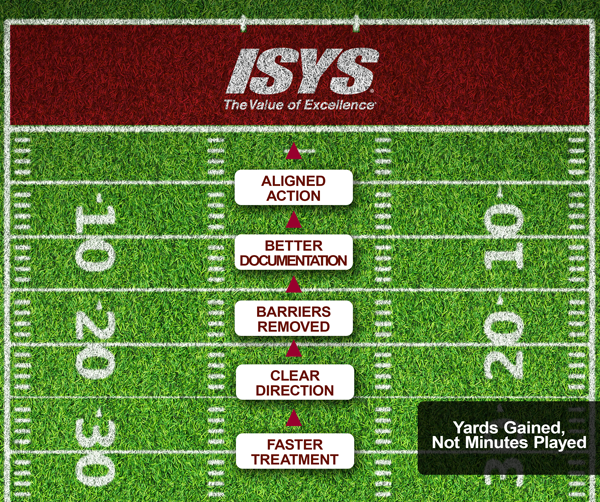 The CaseSmart® Approach is anchored in strategic intervention: deploying nurse case management in ways that create measurable movement in the claim, not just recorded engagement. This includes focusing effort on the factors that most often influence claim outcomes, such as care progression, clinical clarity, functional recovery, and avoidable delays.
Instead of equating value with frequency of outreach, the CaseSmart® Approach emphasizes outcomes such as:
- Accelerating treatment progression by reducing scheduling and care-access friction
- Tightening clinical direction through clearer provider alignment and next-step planning
- Identifying and addressing barriers earlier—psychosocial risk, workplace mismatch, or communication breakdowns
- Improving work status confidence through functional framing and clearer restrictions guidance
- Supporting defensibility with stronger documentation quality and clearer clinical reasoning
- Reducing unnecessary escalation by aligning stakeholders before issues become entrenched
This is not “less case manager involvement.” It’s more disciplined involvement, targeted where it changes the trajectory of the claim.
Why the Shift Matters in 2026
Medical complexity isn’t decreasing. Provider networks remain strained. Injured workers are navigating broader behavioral health challenges. And claims leadership is increasingly expected to demonstrate program ROI using clean metrics that reflect outcomes, not output.
In that environment, traditional activity-based case manager utilization can inadvertently reward motion over progress. It produces a lot of reporting, but not always a lot of movement. And for organizations managing portfolios across multiple jurisdictions, TPAs, or internal teams, inconsistency in case management value delivery becomes a real performance risk.
The CaseSmart® Approach aligns nurse case management with what senior professionals care most about:
- More predictable claim progression
- Earlier risk identification and intervention
- Stronger coordination between medical care and RTW strategy
- Fewer avoidable delays and handoff breakdowns
- Clearer insight into barriers before they inflate cost and duration
- Measuring Nurse Case Management Like a Performance Function
For high-level claims and risk stakeholders, the most meaningful question isn’t “How many touches occurred?” Instead, it’s “What changed because of nurse case manager involvement?”
In 2026, mature programs will evaluate nurse case management value through indicators like:
- Barriers resolved vs documented
- Treatment momentum improved vs monitored
- Claim direction clarified vs discussed
- Functional recovery supported vs tracked
- Return-to-work progress achieved vs attempted
Because outcomes, not activity, are what reduce total cost of risk, improve injured worker experience, and strengthen enterprise performance.
Busy doesn’t win games. Yards gained do.
And the CaseSmart® Approach is built to move claims forward strategically, measurably, and with leadership-level accountability.
No responses yet